
The Bellamy Co. Blog
Welcome to The Bellamy Co. Blog, where transformation meets inspiration! Our mission is to redefine success for women worldwide, offering change through our Freedom Project.
In here you’ll find stories of women in business, our hot takes on what it means to be successful, testimonies of women in our community, and actionable tools and insights to help you be ready to shatter glass ceilings, follow your career aspirations and achieve personal fulfillment!


Dare to Dream: The Bellamy Co. Origin Story
Ashley's story resonates with aspiring women entrepreneurs as she steers challenges, discovers her passions, and embraces a life driven by desire rather than duty.
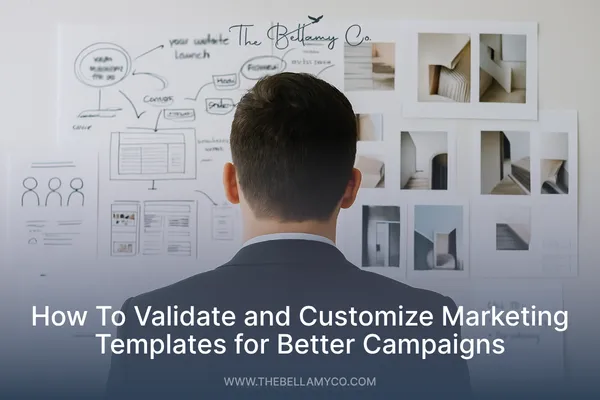
Validate and Customize Marketing Templates for Brand-Specific Campaigns
How To Validate and Customize Marketing Templates for Better Campaigns
Marketing templates for businesses can save time, but they can also quietly water down your brand if you use them as-is. If you have ever turned on a funnel or email sequence and then hoped it was saying the right thing, you are not alone. The real power of templates comes when you slow down, customize them, and turn them into clear, trackable systems that match how your business actually works.
In this article, we are going to walk through how to validate and customize templates so they fit your brand, your offers, and your operations. We will also talk about how to measure what is running, so you are not automating the wrong thing at scale, especially as early Q2 becomes the perfect time to clean things up before summer shifts your schedule.
TL;DR? Here's What's Inside . . .
Take Back Control of Your Done-for-You Marketing
Define Success Upfront with Clear Marketing SLAs
Know What You Are Automating and Why It Matters
Validate Templates Before They Touch Your Audience
Customize Templates so They Sound and Feel Like Your Brand
Turn Plug-and-Play Assets Into Measurable Systems
Avoid the Most Costly Template and Automation Mistakes
Power Your Next Campaign With Ready-To-Use Tools
Stop Copy-Pasting Templates and Start Owning Your Marketing
Templates are tools, not magic. When we treat them as shortcuts, we usually get:
Generic copy that sounds like everyone else
Promises that do not match what we really deliver
Funnels that collect leads but rarely turn into good clients
That copy-paste approach can actually weaken your brand. Instead of feeling clear and confident, your marketing feels random and disconnected from the work you are proud of.
The better mindset: templates are starting points. They give you structure, prompts, and ideas. You bring the decisions, the brand voice, and the data. Early Q2 is a smart time to do this work, when many service-based businesses are resetting after Q1 and planning for summer, whether that means a slower season or a busy one. Use this window to review what you automate, so it supports the season ahead.
Know What You Are Automating and Why It Matters
Before you tweak any copy, you need to see the full picture of what is already running in the background. Start with a simple audit of your marketing templates for businesses and any automations they touch.
Email sequences: welcome, nurture, launch, reactivation
Funnels and landing pages: freebies, waitlists, applications
Social templates: captions, promo posts, DM scripts
Workflows: tags, follow-ups, task automations in your CRM
For each asset, answer one question: What is the main job here? Most marketing pieces fall into one of these roles:
Lead generation
Nurture and education
Conversion to a core offer
Upsell or cross-sell
Retention or renewal
Reactivation of past leads or clients
If you cannot name the job of an asset, you cannot measure it or meaningfully customize it.
Then, spot your “automation risk zones.” These are messages that affect pricing, promises, onboarding steps, or client expectations. Anything that says when something will be delivered, what is included, or how much access a client gets should be carefully reviewed before you put more traffic through it.
Validate Templates Before They Touch Your Audience
Now we move from “what do we have?” to “should this even run?” Every template you borrow should pass three simple checks before it goes live.
1. Brand and offer alignment
Check that the template’s assumptions match your real business. Look for hidden guesses about:
Who your audience is
What main problem do they have
How do you solve it
Your pricing level
How you deliver the service
If the template is written for a different business model, you will feel it in the tone and the promises. Adjust or drop anything that does not fit.
2. Message-market fit
Swap any generic lines with language your real clients use. Pull from:
Sales calls
Emails and DMs
Testimonials and feedback forms
Cut jargon that your clients never say. Remove claims, timelines, or guarantees that your current operations cannot support. On the back end, if your team is in a busy season or dealing with weather delays or travel, your automation should not promise overnight miracles.
3. Baseline measurement
Assign one primary KPI to each asset. For example:
Email: click-through rate
Landing page: opt-in or application rate
Booking page: call booking rate
Pick a simple benchmark that feels reasonable so you can tell whether a template is helping or just filling space.
Customize Templates so They Sound and Feel Like Your Brand
Once a template passes basic validation, it is time to make it sound like you, not the original creator.
First, codify your brand voice. Write down 3 to 5 traits, like:
Direct and clear
Warm and supportive
Practical and data-informed
Then list words or phrases you use often, and ones you avoid. Apply this lens to every line of a template. If it feels like something you would never say out loud, rewrite it.
Next, line up each template with your true client journey. Map out the steps from first touch to renewal. Where does this asset sit?
Before a lead opts in
Right after they join your list
Before or after a sales call
During onboarding
Near renewal
Adjust timing, calls to action, and expectations so they mirror what really happens when someone works with you.
Finally, localize and adapt for the season and your niche. If you are heading into Q2, mention planning, mid-year goals, or preparing for summer schedules. If your clients deal with weather-related cycles, name what is actually happening in their world. This small touch makes even a basic template feel timely and thoughtful.
Turn Plug-and-Play Assets Into Measurable Systems
Individual templates are nice. Systems are what actually scale. Your goal is to group related templates into simple, trackable flows.
For each campaign, define:
A clear starting trigger: what kicks this off?
A clear ending point: when is this done?
Decision points: what happens if someone clicks, books, or ignores?
Use your CRM or an all-in-one platform to connect each asset to tags, stages, and basic dashboards. You want to see how a subscriber or lead moves from step to step, not just how one email performs alone.
Then, commit to structured experiments. Instead of rewriting everything when results are flat, change one variable at a time:
Subject line
Call to action
Send time or delay
First paragraph hook
Run these tests in 30-day sprints. This keeps you moving without constant chaos.
Avoid the Most Costly Template and Automation Mistakes
There are a few traps we see service-based businesses fall into with marketing templates for businesses.
First, do not automate broken experiences. If your operations, fulfillment, or client communication are already strained, more automation will only make problems louder. Make sure any promised timelines, bonuses, or access are realistic for your current capacity.
Second, watch out for “Frankenstein funnels.” When you mix templates from many different sources without a shared strategy, people feel it. They get:
Confusing tone shifts
Conflicting offers
Repeated or clashing next steps
Unify your core offer, tone, and journey before you flip the switch.
Finally, set review cadences. Schedule a simple quarterly review to:
Retire outdated language and old programs
Update timelines and seasonal hooks
Fix broken links or references to past events
That way, your automations do not quietly go stale while you are busy serving clients.
Turn Today’s Templates Into Tomorrow’s Signature System
The goal is not to collect more templates. The goal is to turn what works into your own repeatable playbook.
When a campaign performs well, save the final versions as your version 1.0. Note the:
Subject lines that worked
Timing between emails
Landing page angle that pulled in the right people
Standardize these inside your main platform so your team can use them across offers and seasons, instead of starting from zero each time.
From there, plan your next 90 days with a simple focus:
One campaign to validate and clean up
One campaign to fully customize to your brand and journey
One campaign to track more closely and improve with small tests
This is the kind of work we support at The Bellamy Co., blending strategy, operations, creative, and tools like our Elevate360 platform so service-based businesses can confidently scale what they automate, without losing the soul of their brand along the way.
Power Your Next Campaign With Ready-To-Use Tools
Save hours of setup time and keep your message consistent across every channel with our curated marketing templates for businesses. At The Bellamy Co., we’ve built these tools to be practical, customizable, and easy for your team to adopt quickly. Explore the templates that fit your goals, then reach out and contact usif you want support tailoring them to your next campaign.

Facebook
Instagram
LinkedIn
TikTok