2026 Digital Marketing Trends: What Businesses Need to Know
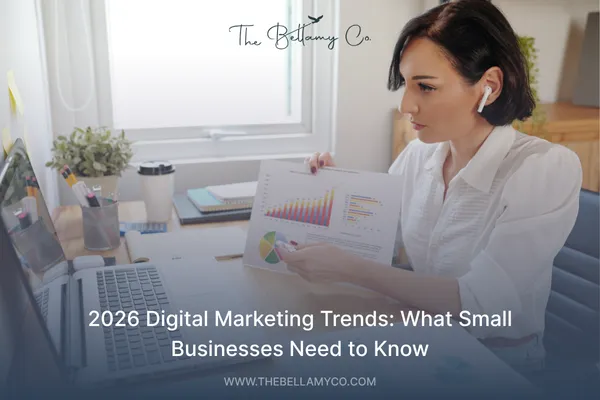
2026 Digital Marketing Trends: What Small Businesses Need to Know
We’ve got some good news for all CEOs out there feeling stretched thin: 2026 is bringing some serious trends that can change how you do business. We’re talking about shifts that will let you:
Take back your time
Build stronger, more human connections
Simplify your tech stack without sacrificing performance
Stay ahead without burning out
Do more with a lean team
Earn trust in a skeptical digital world
In this post, we’re breaking down the top 2026 digital marketing trends and showing you how to use them to work smarter, scale sustainably, and finally make marketing feel manageable.
TL;DR? Here's What's Inside . . .
2026 Digital Marketing Trends: What Small Businesses Need to Know
What customers expect from brands in 2026
What small business owners should do next
#5 SEO, AEO, and content marketing
#6 Interactive & video content: Don’t just tell, show
#7 Data privacy, first-party data & trust building
#8 Purpose-driven digital marketing
1. I’m not “tech-savvy.” Can I really use AI in my marketing?
2. How much does marketing automation cost?
3. Is video marketing really necessary for small brands?
4. What’s the first step I should take to future-proof my marketing?
5. Do I need to completely rebuild my marketing system to keep up with 2026 trends?

What customers expect from brands in 2026
Before we dive deeper into what’s trending, let’s step back and look at what’s driving it all: customer expectations. Because at the end of the day, marketing trends don’t exist in a vacuum; they’re responses to how people think, behave, and buy. So, what exactly are customers looking for in 2026?
1. Efficiency & time-saving experiences
Customers expect seamless, fast, and convenient interactions. If your website, checkout, or communication process slows them down, they’ll move on quickly.
2. Clarity & simplicity in messaging
People are overloaded with information. They want brands to be clear, direct, and easy to understand.
3. Personalization that feels thoughtful, not invasive
Buyers want content and recommendations tailored to their needs, but without feeling like they're being watched. They expect relevance without creepiness, and personalization that respects their privacy.
4. Trust & long-term relationship building
Consumers are drawn to brands they can trust. In 2026, transparency, authenticity, and values matter just as much as product features or price.
5. Consistency across channels
Customers interact with brands across multiple touchpoints, such as social media, email, websites, and apps. They expect a consistent experience, no matter where they connect with you.
6. Adaptability & relevance in real-time
In a world that shifts fast, customers expect brands to keep up. Whether it’s responding to trends, addressing social change, or updating offers based on real-time needs, agility wins attention.
So, what’s the answer to all of this? You’ll find it in the 2026 digital marketing trends. Next year is about building smarter, more human, and more responsive brand experiences that meet your audience where they are and how they want to be engaged.

#1 AI in digital marketing
The year 2026 isn’t about experimenting with AI anymore, but how well you use it. If you’re still using AI as a search engine, you’re already behind! AI has so much more to offer, and as a business owner, you need to think about how to use all its capabilities in your system.
So what’s changed?
AI is now shaping full marketing strategies, not just creating content. It analyzes customer behavior and campaign data to help you determine the next steps.
Personalization is smarter and more dynamic. AI can adjust emails, product recommendations, and even website content in real-time based on a customer's actions.
Customer journeys are now AI-powered. You can map out and optimize every touchpoint using real-time insights.
Content quality has leveled up. AI tools are faster and more accurate, enabling you to create branded content that sounds human.
Customers care how you use AI. People want brands to be transparent about where AI is being used and to ensure it enhances the experience, rather than replacing the human touch.
What small business owners should do next
From now on, you must be intentional about how you utilize AI to grow your business. Here’s how to get started:
Audit your current workflow. What’s taking up too much of your time? Content creation? Email follow-ups? Use that as your starting point for AI support.
Choose one task to automate. Pick something low-risk but time-consuming, like social media scheduling, and start using an AI tool to handle it.
Use AI to personalize without adding extra work. Set up automated email flows or product recommendations that change based on customer behavior.
Track performance and adjust. Most AI-powered platforms include built-in analytics. Review the data weekly and let it guide your next move.
You don’t need to “master AI.” Just start where you are and build step by step. It’s one of the easiest ways to kickstart your small business digital transformation and free up time to focus on growth.
Do you need help setting up AI support? We’re here to help book a FREE consultation call with us or browse our digital marketing services.

#2 Marketing automation
We’ve said it before, and we’ll say it again: automation saves you hours of busywork—and we stand by its ability to transform how you run your marketing.
In 2026, SMB marketing automation setup is becoming the secret sauce behind every lean but effective marketing strategy.
What's working now:
Email sequences that adapt based on user behavior (opens, clicks, purchases)
Social media scheduling tools that use AI to suggest timing, content, and hashtags
CRM systems that trigger personalized follow-ups automatically based on customer actions
You don’t need to feel intimidated by automation at all. Today’s tools are smarter, simpler, and designed for non-techie business owners who need results without the overwhelm.
Automation does not equate to impersonal. When done right, automation enhances personalization, rather than replacing it. You can still tell your story, showcase your aesthetic, and build brand trust without burning the midnight oil.
Curious how automation could look for your business? Visit our article on Types Of Marketing Automation For Startups And Small Businesses

#3 Tech integration
Not long ago, a client came to us overwhelmed by a bloated tech stack. They were using more than 10 different tools that didn’t connect, and nothing worked the way it should. They were wasting hours moving data, chasing down leads, and paying for software they barely touched.
We helped them cut their tools in half and build a streamlined system where everything worked together in one place. Their processes became more efficient, consistent, and significantly less stressful.
In recent years, small businesses have stacked too many tools to keep up, only to end up with more complexity and less clarity. In 2026, the shift is clear: businesses are moving toward simplified, connected systems that save time and give a full view of what’s working.
That’s why marketing tech integration services are essential; they help replace scattered tools with smarter, scalable systems that actually work together.
What smart integration looks like:
One central hub where you manage content, leads, and campaigns
Unified analytics that show what’s working (and what’s not)
Systems that scale with your growth, not against it
Simple systems scale. Complex ones slow you down. If your tools are creating more work than they solve, it’s time to clean things up.
We work with brands like yours to streamline their tech infrastructure and establish smart, scalable systems. Explore how our marketing and operations platform, Elevate360, can help.

#4 Personalization at scale
One of the most important 2026 digital marketing trends is personalization. It is expected to be smarter, deeper, and more meaningful. Customers now want experiences that feel tailor-made for them, and with the help of AI and advanced automation, that’s more achievable than ever, even for small teams.
Here’s what personalization looks like today:
Websites that adapt content based on user behavior or location
Product or service recommendations powered by real-time data
Emails that adjust based on what someone previously clicked, not just what list they’re on
So, why does this matter? Because personalization is a main driver of performance, it increases open rates, boosts conversions, and builds real trust. More importantly, it allows you to speak to different customer journeys without creating endless versions of your messaging.

#5 SEO, AEO, and content marketing
Content is evolving, and in 2026, content marketing is less about stuffing keywords and more about creating value that your audience actually cares about. Thanks to AI, you can move faster, but what really sets great content apart is strategy, clarity, and voice.
Here’s the sweet spot:
Let AI help with research, outlines, and first drafts
Add your unique tone, insights, and brand story
Publish content that ranks and has a human touch
Now, let’s talk AEO, a.k.a. Answer Engine Optimization. This is a major shift in how content is discovered. Platforms like Google’s Search Generative Experience (SGE) and ChatGPT are providing users with direct answers, rather than just serving up links.
But here’s the key: AEO builds on SEO. Before your content can be featured in an answer engine, it needs to be findable, crawlable, and optimized correctly. So yes, your SEO game still matters—maybe more than ever.
Think of it like this: SEO gets you in the room, but AEO gets your answer chosen.
That means:
Structuring content so it’s clear, scannable, and solves real problems
Using FAQ sections, schema markup, headers, and clean formatting
Prioritizing trust, helpfulness, and relevance
Strong SEO gets your content found, AEO helps it get chosen, and great content keeps your audience coming back. In 2026, you need all three working together to achieve a next-level small business digital transformation.
Worried about your search presence? Dive deeper into proven SEO strategies in our blog: Boost Digital Presence With Onsite & Offsite SEO Strategies

#6 Interactive & video content: Don’t just tell, show
In 2026, passive content is out. Interactive and video content is where attention lives now. People want to experience your brand, not just read about it.
What’s driving engagement today:
Short-form video on platforms like TikTok, YouTube Shorts, and IG Reels
Interactive elements like quizzes, polls, and “choose your own adventure” experiences
User-generated content (UGC) that builds trust and adds social proof
You don’t need a full film crew to make it happen. Tools like CapCut, Canva, and Descript make content creation incredibly accessible, even for those without video editing experience.
What does this mean for your brand? It means showing your process, not just your product. It involves repurposing long-form content into video clips that are more easily consumed and shared. And it means adding clickable polls or carousels to boost engagement and make your content more interactive.

#7 Data privacy, first-party data & trust building
Let’s talk about the elephant in the inbox: privacy. With tighter regulations, ad platform changes, and cookie phase-outs, relying on 3rd-party data is officially a thing of the past.
In 2026, first-party data is the foundation of effective marketing. These are insights your customers willingly share with you, such as:
Email signups
Quiz responses
Website behavior
Purchase history
Unlike third-party data, this information is:
Direct — it comes straight from your audience
Accurate — no guessing or unreliable sources
Trust-based — customers choose to share it with you
First-party data is more ethical, more compliant, and far more effective. It allows for smarter personalization without crossing boundaries, and it builds real trust between you and your audience.
The brands that will win in 2026 are those that treat privacy as a brand-building opportunity. Be clear, transparent, and generous with what people get in return for sharing their data, and they’ll stick around longer.

#8 Purpose-driven digital marketing
In 2026, it’s not enough to sell a good product. You need to stand for something. Especially for solo founders and small businesses, your brand values can be your biggest marketing asset.
People want to buy from brands that:
Care about sustainability
Support communities
Are inclusive and ethical
Lead with transparency
This is not performative marketing but authentic storytelling that reflects your brand’s purpose. Now, how can you bring this into your marketing?
Share behind-the-scenes moments
Highlight the causes you support
Talk about the why behind your brand
Remember: People don’t just buy what you do, they buy why you do it.

Frequently asked questions
1. I’m not “tech-savvy.” Can I really use AI in my marketing?
Absolutely. The best AI tools in 2026 are designed with user-friendliness in mind. Many platforms offer drag-and-drop interfaces, automated workflows, and pre-built templates to help you get started.
2. How much does marketing automation cost?
It varies. Many tools offer entry-level pricing for small businesses, and some even provide free options to get started. The key is choosing tools that integrate well so you're not overpaying for software you barely use.
3. Is video marketing really necessary for small brands?
Yes, but it doesn’t have to be complicated. Consumers today engage more with short-form video than static content. You can record with your phone, use AI tools to edit, and create engaging content without the need for fancy production.
4. What’s the first step I should take to future-proof my marketing?
Take a look at your current systems: what's working, what's draining you, and where are your gaps? Then focus on marketing tech integration services, AI-driven content, and setting up automation to save time. Or better yet, book a free consultation with us and let’s map it out together.
5. Do I need to completely rebuild my marketing system to keep up with 2026 trends?
Not at all. Start by optimizing what you already have. Minor upgrades, such as connecting your tools or automating repetitive tasks, can have a significant impact without requiring a complete overhaul.

Your 2026 Marketing Game Plan Starts Now
The 2026 digital marketing trends we covered aren’t just fads. They’re the foundation of lean, efficient marketing that works for real small businesses like yours.
You don’t need to be a tech guru or have a massive budget to win in 2026. You just need a clear plan, the right tools, and maybe a little expert backup. That’s what we’re here for: to simplify your marketing and build systems that scale with you.
Ready to streamline your marketing, free up your time, and grow your business? Book a FREE discovery call with our team here.