

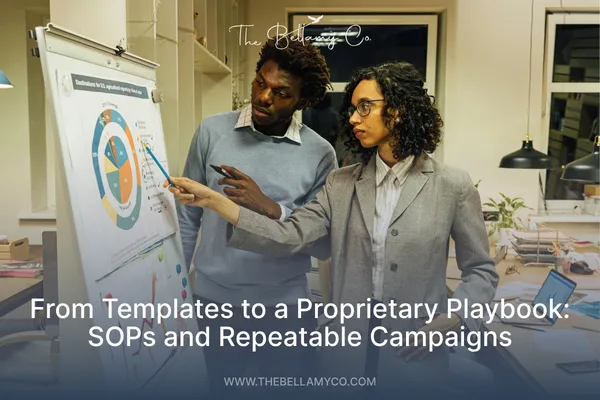
Build a Marketing Playbook Beyond Business Templates
From Templates to a Proprietary Playbook: SOPs and Repeatable Campaigns
Most service-based businesses start the same way with marketing. You grab a few Canva graphics, some email swipes you liked, maybe a social caption bank, and a launch checklist. You plug them into your next promo, and it works well enough. Then everything disappears into a folder you cannot remember the name of later.
Those marketing templates for business help you move fast in the moment, but they do not give you a real system. They do not explain why something worked, when to use it again, or how to help your team repeat the win. So every new campaign feels like starting with a messy scratch file.
A proprietary marketing playbook is the next step. It is a living system that pulls those scattered assets into one place, adds context, and turns your best ideas into repeatable plays your whole team can run. As we move into late March and early spring, it is the perfect time to tidy up, reset, and upgrade how you run marketing before the busy middle of the year hits.
In this article, we will walk through how to capture lessons from past campaigns, document simple SOPs, and turn your favorite
TL;DR? Here's What's Inside . . .
From Templates to a Proprietary Playbook: SOPs and Repeatable Campaigns
TL;DR? Here's What's Inside . . .
Why Templates Alone Keep Your Marketing Stuck
Capture the Gold From Past Campaigns
From Templates to SOPs That Actually Work
Build a Repeatable Campaign System You Can Run Each Quarter
Turn Your Playbook Into a Competitive Advantage
Streamline Your Marketing With Ready-to-Use Templates That Actually Work
Why Templates Alone Keep Your Marketing Stuck
Templates feel helpful because they save time. You are not staring at a blank screen; you are filling in blanks. But templates on their own rarely improve your strategy. They answer what to do, not why you are doing it or how it all fits together.
When you rely only on templates, a few common problems show up:
Disjointed campaigns that feel random across channels
Inconsistent brand voice from email to social to sales pages
Heavy dependence on one or two people who “remember how we did it last time”
Constantly rebuilding launches and promos every quarter
That happens because static templates are missing context. They:
Do not record the decisions that went into the campaign
Do not show you the order of tasks and reviews
Do not track results in a way your team can use later
A proprietary playbook is different. It turns your templates into part of a bigger system. Instead of a loose folder of files, you have a clear answer to questions like:
Why are we choosing this offer now?
When do we start planning, and who owns each piece?
In what order do we design, write, approve, and publish?
Templates alone are like puzzle pieces in a drawer. A dynamic playbook gives you the picture on the box and the steps to put it together the same way each time.
Capture the Gold From Past Campaigns
Before you build new systems, you want to mine what you already have. Every launch, seasonal promo, or enrollment push has hidden gold inside it, even the messy ones. The goal is to identify patterns and lessons, so you stop repeating the same mistakes.
Start with a simple review of your last few campaigns:
Which channels actually drove leads and sales
Which messages or angles people responded to
How long things really took compared to your plan
Where bottlenecks showed up, like design, approvals, or tech
Then, use a standard debrief template after each campaign. Keep it simple:
Objective: What were we trying to achieve?
Results: What actually happened?
What worked: What should we repeat?
What flopped: What needs to change or go away?
Root causes: Why did those things happen?
Next time: What will we repeat, revise, or retire?
The key is to store these in one shared place, not scattered across random docs. Create a “Campaign Insights Hub” in your project tool or shared drive. Each campaign gets its own short debrief. Over time, this hub becomes your library of what works for your brand, your audience, and your offers, not just general marketing tips.
Here in the Southeast, spring often feels like a reset after a gray winter. Treat this season the same way for your marketing. Clean out old folders, pull out the campaigns that mattered most, and log the lessons before they fade.
From Templates to SOPs That Actually Work
Now it is time to turn your best marketing templates for business into clear, simple SOPs. An SOP, or standard operating procedure, is just a step-by-step guide for how your team does a specific task or process.
Think of SOPs as the missing layer between your ideas and your templates. For each key asset, you want to answer:
When do we use this?
Who is involved?
What are the steps, in order?
How do we measure if it worked?
For example, say you have a strong email launch sequence template. Pair it with a basic SOP that covers:
When this sequence is right, like new offer launches or seasonal pushes
How to customize the subject lines and stories for the current campaign
Timelines for drafting, review, and scheduling
KPIs to track, like open rate, clicks, and replies
You do not have to start with flawlessly written docs. A low-pressure way to begin is:
Record a Loom or screen share while you or a team member walks through the process.
Outline the major steps in simple bullet points.
Have someone lightly clean it up into a written SOP later.
Assign a clear process owner for each SOP. Their job is to keep it updated as your strategy shifts so your system grows with you, instead of getting stale.
Build a Repeatable Campaign System You Can Run Each Quarter
Once you have insights and a few SOPs, you can design a simple campaign playbook you can reuse every quarter. Think of it as your “this is how we launch” manual, whether it is a spring promo, a Q2 enrollment push, or a year-end client retention drive.
A basic campaign playbook includes:
Core phases: Plan, create, launch, optimize, debrief
Roles: Who owns strategy, copy, design, tech, and reporting
Timelines: When each phase starts and ends
Assets: Which templates and SOPs go with each phase
For example, your “Q2 Enrollment Push” flow might look like:
Plan: Decide offer, goals, and main message, pull insights from your Campaign Insights Hub
Create: Use your email, social, and ad templates, guided by related SOPs
Launch: Follow the launch checklist and calendar, with clear daily tasks
Optimize: Check KPIs mid-campaign and adjust subject lines or ads
Debrief: Run your standard debrief and log it in the hub
With this type of system, you can bring in contractors or new hires without chaos. They can see how you do things, not just what needs to be done. Brand voice stays more consistent, projects move with less back-and-forth, and your marketing grows in depth without burning out your core team.
Turn Your Playbook Into a Competitive Advantage
Want more resources and templates to get started? Visit our tools and resources page. We offer a comprehensive suite of resources designed to streamline your workflow, including detailed Standard Operating Procedures (SOPs), campaign frameworks, and customizable templates for various marketing activities. Elevate your strategy and execution today with our curated content and guides.
To start, do not try to systemize everything at once. Pick one upcoming campaign, like a spring offer refresh or a Q2 launch, and treat it as your pilot. Run the campaign, but this time, commit to documenting as you go and debriefing at the end.
From there, take a few clear next steps:
Audit your current marketing templates for business and delete dead weight
Choose 3 to 5 high-impact processes to standardize first, like launches or monthly content
Create one central “Marketing Playbook” folder for SOPs, templates, and insights
Add a short quarterly review to refine and expand the playbook
At The Bellamy Co., we care about helping service-based businesses move from ad hoc marketing to integrated, systems-driven brands. When your campaigns build on each other instead of starting fresh every time, your marketing feels lighter, smarter, and far more repeatable for you and your team.
Streamline Your Marketing With Ready-to-Use Templates That Actually Work
If you are ready to save time and stay consistent with your brand, explore our proven marketing templates for business curated to fit real-world needs. At The Bellamy Co., we build tools that help you move from idea to implementation without getting stuck in the details. Start with the templates that match your current goals, and if you need tailored guidance, feel free to contact us so we can help you choose the right fit.